
By Sai Prahlad K, chess coach and founder of Seed Succeed Academy, Chennai.
Our learning site for young children has a new address: learnchess.pro/kids. It used to sit on a separate web address. Now it is part of the main site, one link to remember and one link to share. The old links still bring you here.
It is called Empower Kids. It is free, there is nothing to install, and a child does not need an account to play. I want to explain why I built it and walk you through what is inside.
Why I built it
Two reasons, and they are simple ones.
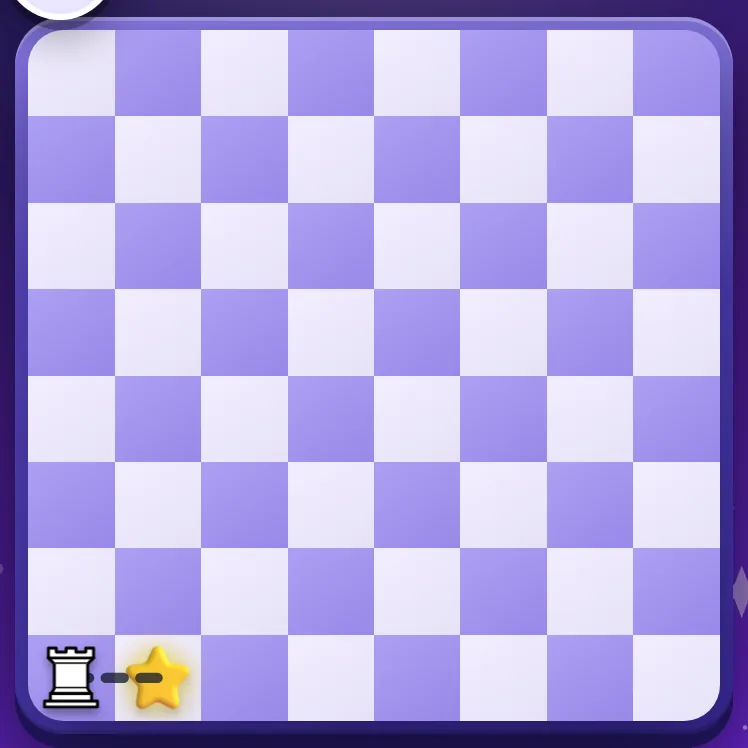
The first is joy. A small child who taps a star and watches a rook slide across the board to collect it is not studying. They are laughing. I wanted to put more of that into the world, for any child, anywhere, whether or not their family can pay for classes.
The second is speed. I am a father and a coach. I wanted my own children and my students to learn faster than a weekly class allows. In a classroom, a beginner gets a few minutes of my attention and then waits. A good game does not make a child wait. It gives the next small task at once, and the child repeats the idea until it becomes a habit.
Those two reasons point the same way. Children learn fastest when they are enjoying themselves, so I built the enjoyment first.
The rules I set for myself
No reading needed. A three-year-old cannot read instructions. In the first games, the squares a piece can go to light up. The board is the teacher.
No wrong moves in the first games. Only legal squares can be tapped. A small child never sees a red cross or hears a buzzer. There is only the next square to try.
A reward every time. Each success brings a burst of colour, a sound and a word of praise, spoken aloud.
The child sets up nothing. Language, voice, sound, piece style and board colours are in a Grown-ups menu. The child only plays.
Free, and no account. There is no advertising aimed at children, no chat and no public profiles.
For older children the rule changes a little, on purpose. The answer is no longer lit up. The child has to find the move, and a wrong try simply means "try again". That is where play turns into training.
A walk through the games
There are more games than I can list here. This is the order I would use with a new child.
1. How each piece moves
- Star Safari: collect stars with the rook, the bishop and the queen. Fifteen levels. Most children start here.
- Animal Kingdom: every piece appears as an animal looking for fruit, so each one's movement is learnt in turn.
- Pawn March: walk a pawn up the board, collect gems and turn it into a queen at the far end.
- Knight's Tour: hop the knight around until it has visited all 64 squares.
- Color Race: two bishops race, each on its own colour. A child sees that a bishop never changes colour without being told.
- King's Escape: walk the king to its castle, one step at a time, while a dragon follows.
- Piece Mazes: steer each piece through walls to the door using only its real moves. Twenty levels.
Alongside these, Find the Square teaches the names of the squares and Match the Piece teaches the names of the pieces.
2. Capturing and seeing danger
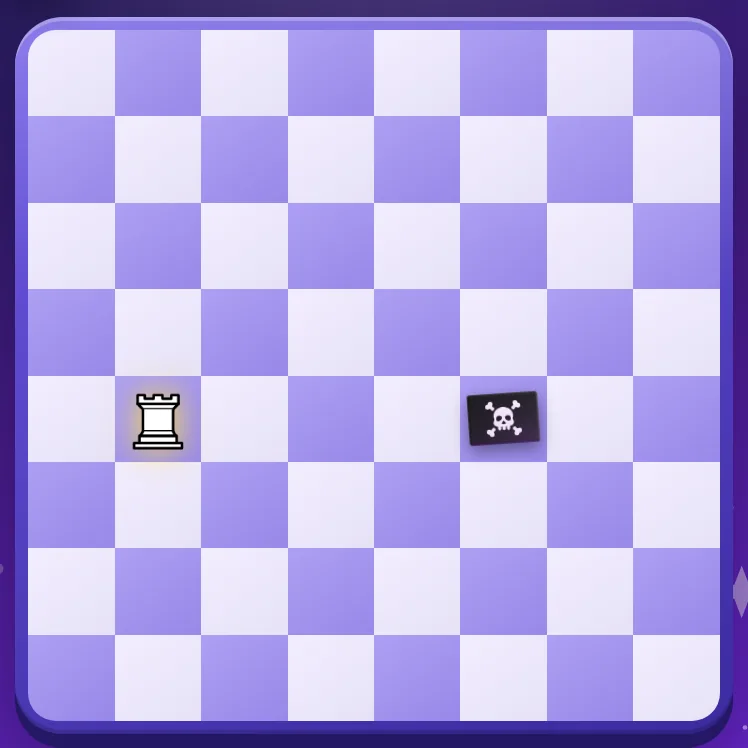
- Pirate Hunt: tap the piece that can capture the pirate. A child's first real captures.
- What Can It Capture: one piece glows, and the child taps every enemy it can take.
- Under Attack and Who's Protected: tap your pieces that are in danger, then the ones a friend is guarding. This is the habit I most want beginners to build.
- Pirate Chase: the first game where the other side moves back. You move, the pirate runs, and you corner it.
3. Check and checkmate
A king in check has three ways out, and each has its own game: move away in Run!, put a piece in the way in Block the Dragon, or take the attacker in Capture the Attacker. Save the King then mixes all three.
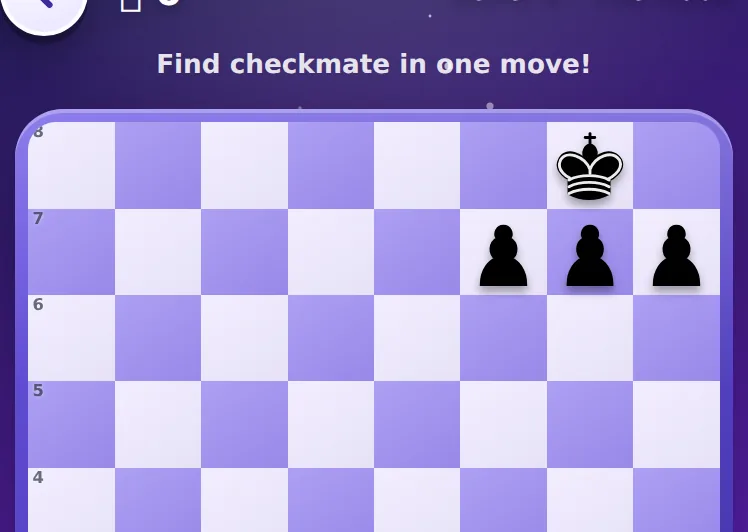
After that come Checkmate!, where the child finds mate in one move without a hint, and Mate in 2 and 3.
4. Tactics and puzzles
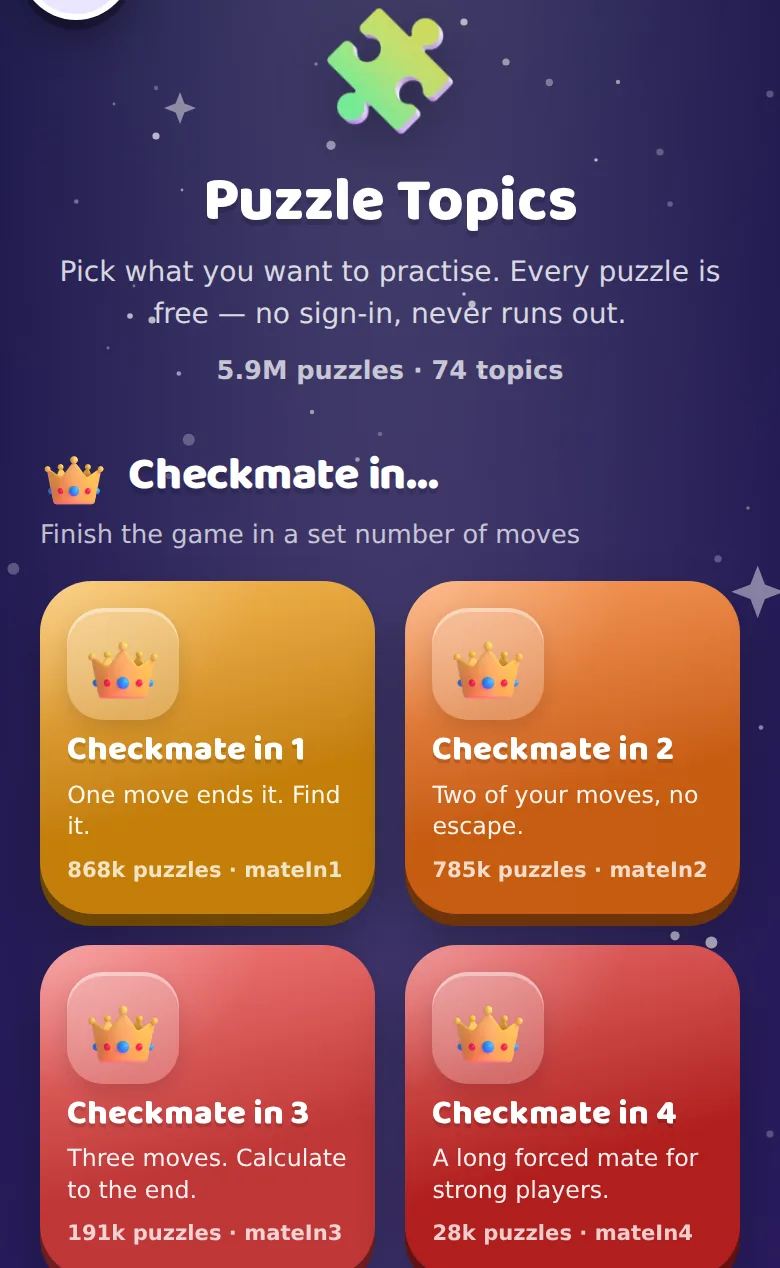
Puzzle Topics has 74 topics, such as forks, pins, skewers and mate in one, drawn from the open Lichess puzzle collection. After a puzzle is solved, a short sentence under the board says why the move worked.
The Daily Quest gives four short tasks each day, including real chess puzzles, and keeps a streak for children who like one.
5. Endgames
In Endgames the child plays a winning position all the way to checkmate against a defender that does not make mistakes. There are also separate puzzle sets for rook, queen and pawn endings.
6. Openings and real games
- Opening Drills: learn the first moves of 20 well-known openings, then play them back from memory.
- Predict the Move: step through a world champion's game and decide what you would play before the move is shown.
- Play vs Computer: a full game, with 15 levels from very gentle upward.
The guided course
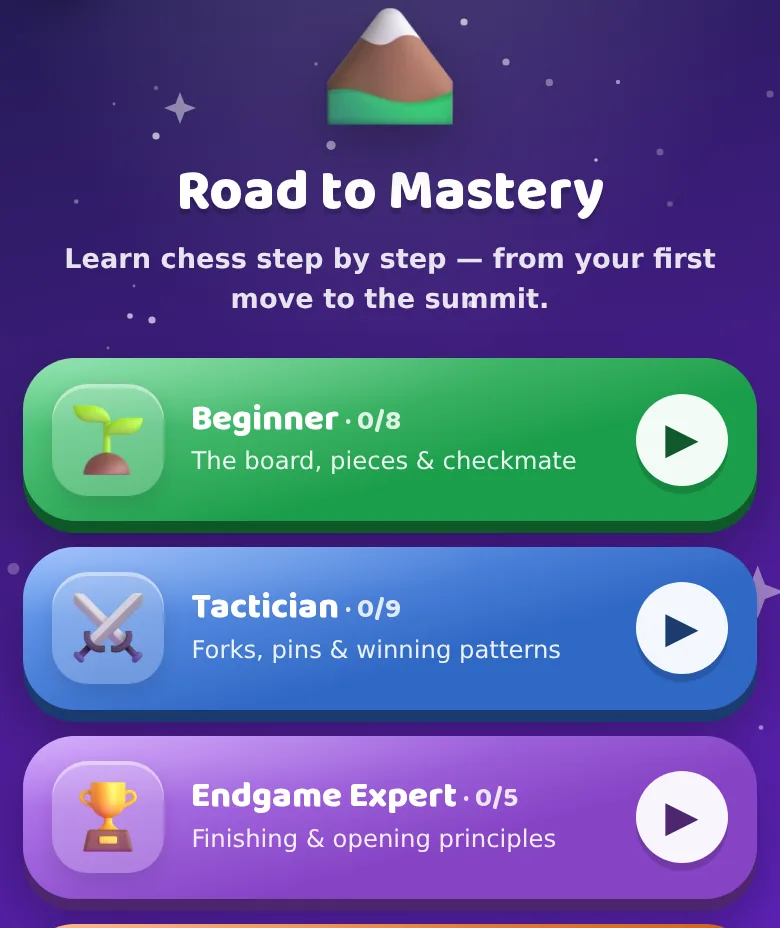
If you would rather follow a set path, Learn chess step by step is a course of nine levels and 58 short lessons. Each lesson is explained with a voice and a board, then practised with one of the games above or with real puzzles. The first level is the same beginner syllabus I teach in my own classes: the board, the pieces, how they move, capturing, special moves, check and checkmate.
More than chess
Chess is the heart of the site, but children asked for more, so there are also games for maths, reading, writing, science, drawing, music and knowing the world. They all open from the same front page.
For parents: start in under a minute
- Open learnchess.pro/kids on any phone or tablet.
- Tap Star Safari and hand the device over.
- If you want another language, open the Grown-ups menu. The spoken praise is available in English, Tamil, Hindi and more than a dozen other languages.
That is all. Progress is kept on the device. If you would like it saved across devices, a parent can create a free account on learnchess.pro and sign in. The child never needs to.
For older children, teenagers and adults who are beginners, the same lessons are at learnchess.pro/learn, in a plainer, grown-up look.
For coaches and schools
You are welcome to use all of this in your classes. Because there is no sign-up, a whole room of children can begin in the time it takes to open a link. The course follows a clear order, so you can set one lesson as homework and know what was practised. If you run a school or an academy and would like help planning chess lessons around it, write to us through seedsucceed.com.
What is still coming
Some things are not finished, and I would rather say so. Daily Quest streaks are kept per device for now. The puzzles do not yet adjust themselves to each child's level. More games will follow.
If your child plays and something confuses them, tell me. That is how the next version gets better.
Sai Prahlad K