
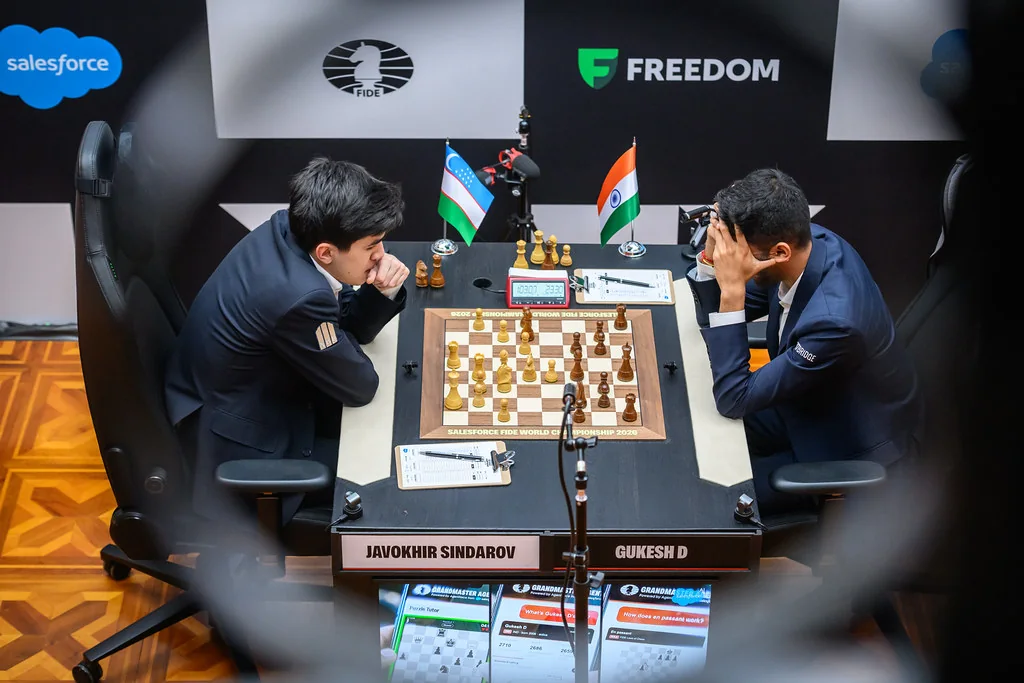
Game 1 of the FIDE World Championship Match 2026, Geneva. Javokhir Sindarov (White) against Gukesh D (Black). Drawn in 38 moves.
The match opened with the Berlin Defence, the opening Vladimir Kramnik used to take the title from Garry Kasparov in 2000. Queens came off on move 8. What followed was quiet, exact manoeuvring, one small slip from each player, a pawn sacrifice, and a draw by repetition.
The game at a glance
1. Moves 14 and 15: the a-pawn runs, the rook waits
Gukesh played 14...a5 and 15...a4. The engine prefers 14...Rd8 both times; the two pawn moves cost Black about a third of a pawn between them. Not a mistake, only a small leak, but it is where White's edge came from.
Where the idea comes from. This a-pawn march is a plan Gukesh has met from the other side. In game 1 of the 2024 match, Ding Liren pushed his a-pawn down the board against him until it hit the base of White's pawn chain, and it worked. We looked at that game here: What went wrong for Gukesh in round 1 of the 2024 match. Two years on, Gukesh reaches for the same tool with Black. The difference this time: in a Berlin endgame the open d-file mattered more than the wing.
The lesson: bring your worst-placed piece into the game before you push pawns on the wing.
2. Move 21: White's one real slip
White stood a little better. The quiet 21.Ne1 kept that. Sindarov chose 21.g4, and the engine's verdict swung by about 0.4 of a pawn, the largest single change in the game. For a moment Black was the one slightly better. Gukesh replied 21...Ke7; the sharper 21...Rd8 would have kept a small advantage.
The lesson: when you have a comfortable edge, check what your active move weakens before you play it.
3. Moves 23 to 26: a pawn for the initiative
With 23...Nxe5 Black won a clean pawn. Sindarov answered 24.f4 and then 26.f5, giving up material for time and open lines. The engine calls it exactly equal with White a pawn down: the compensation was real.
The lesson: ask what you get for the pawn. Here it was specific: a tempo on the knight, the f-file, and the black king pulled forward.
4. Move 32: was there a win?
No. After 32.Bxh6+ Black has exactly one move, 32...Kg8; every other king move loses. Once White chose 33.Rg5+ Kh7, the move 34.Rh5 was forced too. The repetition was correct play from both sides, not a missed chance.
What the clocks say
Gukesh spent about an hour and a half on moves 11 to 17. Sindarov took 23 minutes over 14.c4, 18 over 19.Ng3 and 20 over 22.Ne1. Every long think produced a move within a small fraction of a pawn of the engine's choice.
Three lessons for club players
- Worst piece first. Ask "which of my pieces is doing the least?" and fix that before pushing pawns on the wing.
- Protect an edge before you add to it. An ambitious move that loosens your own position can hand the advantage back in one turn.
- Name what you get for the pawn. Time, an open file, an exposed king: fine. "An attack, somehow": keep the pawn.
All the moves
- e4 e5 2. Nf3 Nc6 3. Bb5 Nf6 4. O-O Nxe4 5. d4 Nd6 6. Bxc6 dxc6 7. dxe5 Nf5 8. Qxd8+ Kxd8 9. Rd1+ Ke8 10. Nc3 Ne7 11. h3 Ng6 12. Be3 Be7 13. Ne4 Bd7 14. c4 a5 15. Rd2 a4 16. Rad1 Be6 17. b3 Bb4 18. Re2 h6 19. Ng3 c5 20. Nh5 Rg8 21. g4 Ke7 22. Ne1 axb3 23. axb3 Nxe5 24. f4 g6 25. Ng3 Nc6 26. f5 gxf5 27. Nxf5+ Kf6 28. Rf2 Rgd8 29. Nd3 Bxf5 30. Rxf5+ Kg7 31. Rh5 Bc3 32. Bxh6+ Kg8 33. Rg5+ Kh7 34. Rh5 Kg8 35. Rg5+ Kh7 36. Rh5 Kg8 37. Rg5+ Kh7 38. Rh5 Kg8 ½-½
How this was checked: every move with a recent development build of Stockfish at depth 22, the critical positions with five lines each. Differences under a tenth of a pawn are treated as noise. Official photos and reports from the match: FIDE World Championship site and Chess.com's coverage.
Want to work through games like this with a coach? Seed Succeed Academy teaches in Madipakkam, Chennai and live online. See how classes work.