
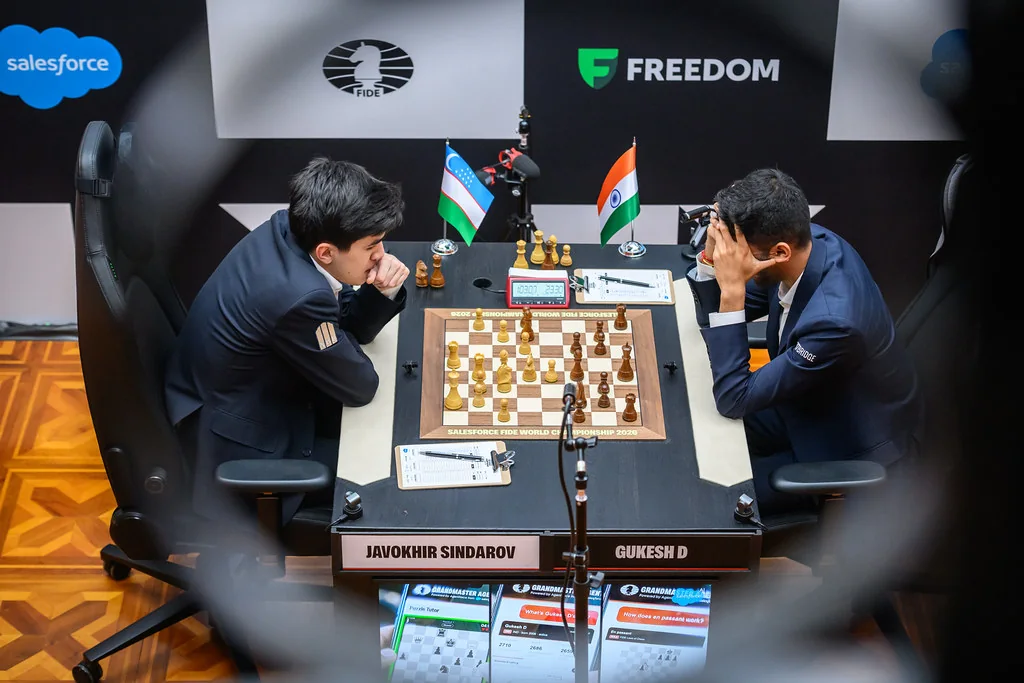
Game 2 of the FIDE World Championship Match 2026, Geneva, 25 November. Gukesh D (White) against Javokhir Sindarov (Black). Drawn in 20 moves. The match stands at 1 to 1.
Gukesh had the white pieces for the first time and chose the London System, an opening many club players and children use themselves. Sindarov met it with a solid setup, closed the centre with his f-pawn, and after a long think from the champion the two repeated moves.
The game at a glance
The engine never gave either side more than about a third of a pawn. Nobody made a mistake; nobody got a chance.
1. Moves 7 to 13: the queen and the rook go out and come back
Sindarov played 7...Qb6, hitting the b2 pawn, the standard question to ask a London bishop that has left c1. Gukesh answered 8.Rb1. Three moves later the queen went home with 11...Qd8, and on move 13 the rook returned with 13.Ra1. Each side spent two moves on the detour, so the account was square.
The lesson: when the bishop leaves c1 early, the b2 pawn is the first thing your opponent will look at. Know your answer before you play Bf4.
2. Move 15: Black builds a wall
White's queen on e2 and bishop on d3 were lined up to support the pawn break e3 to e4, the usual way to open a London position. Sindarov stopped it with 15...f5. The pawns on d5, e6 and f5 are a Stonewall: they lock the centre and give Black a fine square on e4 for a knight. The price is the e5 square, which now belongs to White for good.
The lesson: if you cannot find a plan, find your opponent's and take away the square it needs.
3. Move 16: thirty minutes, then a repetition
Gukesh thought for half an hour over 16.f3, preparing e4 a second time. Sindarov replied 16...Nf6 at once, and e4 was still not possible. Then came Be5, ...Nd7, Bg3, ...Nf6, three times over.
Could White have played on? The engine suggests 17.a5, gaining space on the queenside, and rates it about a fifth of a pawn better for White, against a tenth for the bishop move. That difference is too small to call an error. The clock mattered more.
What the clocks say
After 16.f3 Gukesh had 50 minutes for his next 24 moves; Sindarov had 84. With a level position, no clear plan and half the time of his opponent, taking the draw was the practical choice.
Three lessons for club players
- Know the b2 question. In the London, ...Qb6 comes sooner or later. Rb1, Qb3 and Qc1 are all answers; pick one before the game.
- Fight for the break square. White wanted e4. Black's whole setup, the knight on f6 and the pawn on f5, was aimed at that one square.
- Your clock is part of the position. Equal on the board and far behind on time is not equal. A draw with White is a fair result there.
All the moves
- d4 d5 2. Nf3 Nf6 3. Bf4 c5 4. e3 e6 5. Nbd2 Nc6 6. c3 Be7 7. Ne5 Qb6 8. Rb1 Nxe5 9. Bxe5 Bd7 10. a4 O-O 11. Bd3 Qd8 12. O-O Rc8 13. Ra1 Be8 14. Qe2 Nd7 15. Bg3 f5 16. f3 Nf6 17. Be5 Nd7 18. Bg3 Nf6 19. Be5 Nd7 20. Bg3 Nf6 ½-½
Earlier in the match: Game 1: Sindarov and Gukesh open with a Berlin draw. Schedule and how to watch: the match guide.
How this was checked: every move with a recent development build of Stockfish at depth 22. Differences under a tenth of a pawn are treated as noise. Clock times are from the official broadcast. Photo: FIDE.
Want to work through games like this with a coach? Seed Succeed Academy teaches in Madipakkam, Chennai and live online. See how classes work.